
How 919 Driver Way went under contract in 48 hours at a record-setting ask.
At $4,950,000, 919 Driver Way entered the market priced more than $200 per square foot above any recorded sale in Incline Village's Championship Golf Course community over the past two years, on one of the community's smaller floor plans.
Two days later, it was under contract, with a clean offer, minimal contingencies, emerging from a field of multiple interested buyers. This is the story of how that number got justified before a single showing happened, and what it teaches sellers who think their property might be the exception to the comps rather than an example of them.

Hayden Haffey works exclusively in Incline Village and Crystal Bay, licensed in both Nevada and California with active memberships across multiple regional MLS boards, giving clients exceptional access and market coverage across the entire North Shore.
Before real estate, Hayden worked as a family consultant for young adults with special needs, an experience that shaped the patience, active listening, and calm-under-pressure approach he now brings to every negotiation. He holds Guild Status from the Institute for Luxury Home Marketing and is a graduate of the Nevada Realtors Leadership Academy.
He lives in Incline Village with his wife, Brooke, and their two daughters. That's hyperlocal insight that runs deeper than data, built from genuine investment in the community he serves.
Genuine, respected, with a passion for serving people, Hayden values the opportunity to champion your next real estate endeavor.
919 Driver Way is a single-family home in Incline Village's Championship Golf Course community, a neighborhood best known for larger homes like 998 Third Green Court and 989 Fairway Boulevard. By comparison, 919 Driver Way carries what the local market would call a "smaller" floor plan. On paper, that's a disadvantage. In practice, it became the point of leverage.
The home sits on a south-facing golf course lot, walkable to town, buffered by mature landscaping that gives the backyard a sense of privacy uncommon on a golf course lot. The floor plan is single-level and easily accessible from both the garage and front entry, with additional living space, including flex and guest space, on the lower level.
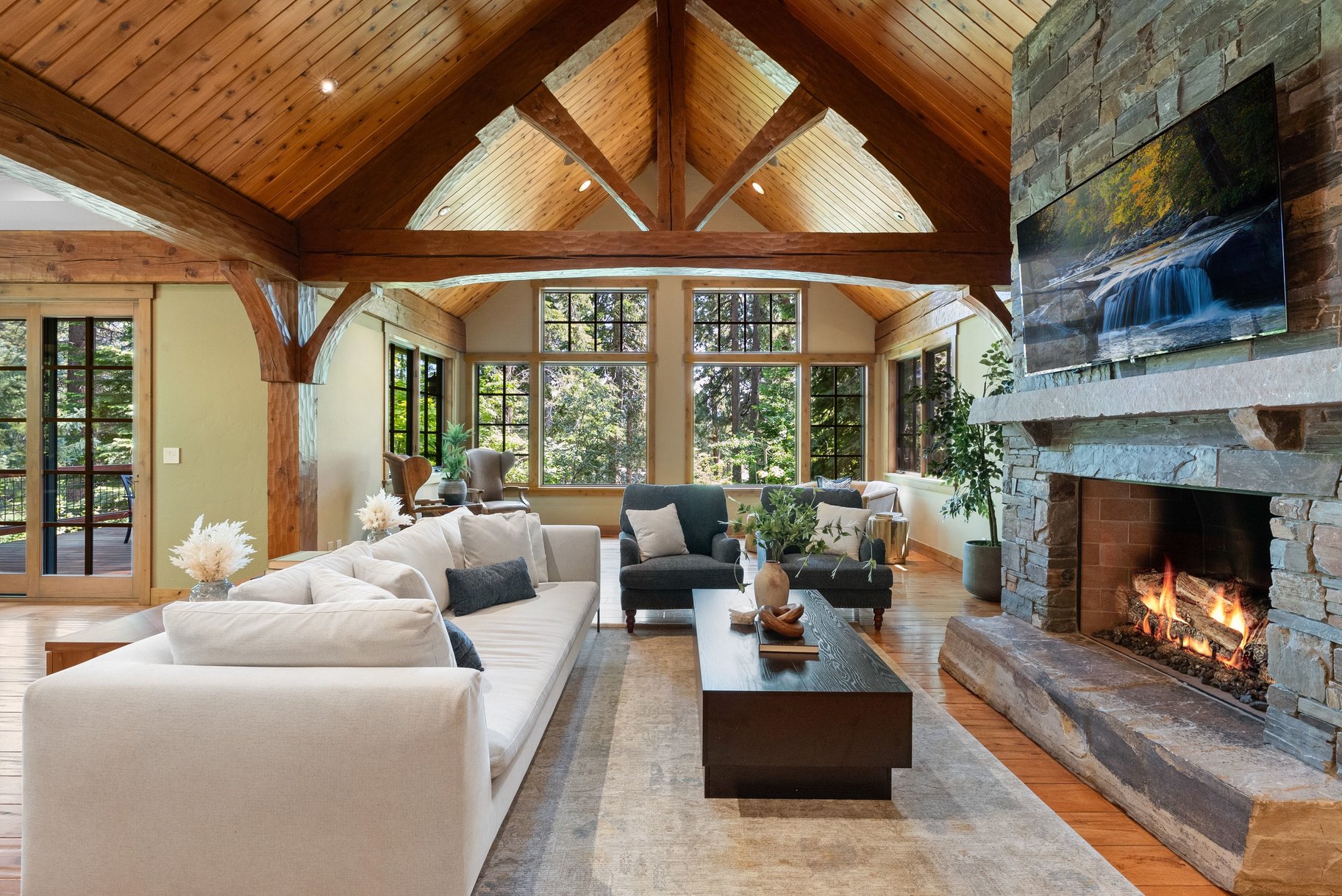
The great room: vaulted wood-beam ceilings and a floor-to-ceiling stone fireplace anchor the home's south-facing living space.
The obvious risk with this listing was optics: a smaller floor plan asking for a record-setting price per square foot reads, at a glance, as overpriced. Before the price could be defended to a buyer, it had to survive an internal audit.
There was no room for a soft spot in the home or the materials that a skeptical buyer, or their inspector, could use to argue the price down.
Every room, every finish, every line of marketing copy needed to hold up under the kind of scrutiny a buyer's agent would bring to a number this bold.
The strategy started with a read on timing, not just the property. Spring was off to a steady start locally, and signals from the Bay Area real estate market and tech sector pointed toward strength moving north. That combination, a strong entry-price environment plus a genuinely scarce property type, created a window to push the ask rather than price defensively to the comps.
Scarcity was the foundation of the case: south-facing homes on this stretch of the golf course, walkable to town, with this kind of privacy and an accessible single-level layout, simply don't come up often.
When supply is this thin, the relevant comparison isn't "what did the last golf course home sell for." It's "how many buyers are competing for the handful of homes that fit this exact need."
That reframing is what allowed the price to make sense before a single buyer walked through the door.
The $4,950,000 list price was set to land more than $200 per square foot above the highest recorded sale in the Championship Golf Course community over the previous two years: a deliberate, not incidental, gap.
That number only works if it's backed by a case, so the case was built first: limited supply of comparable homes, a buyer pool with a specific and underserved need (single-level living with accessible guest space), and a market environment with real spring momentum.
Everything else was built to support it.
The home was decluttered and nearly all of the owner's furnishings and décor were removed, paint was touched up throughout, decks were re-stained, and the landscaping got a full spring refresh. Landscaping wasn't treated as a finishing touch. It was identified early as one of the home's biggest selling points, and the goal was to make the backyard read as a private sanctuary in photos, video, and in person.
New plantings, fresh mulch across the entire property, and sod touch-ups, built to sell the private backyard sanctuary.
Twilight photography and video, drone photography and video, a lifestyle video, and dedicated golf course aerials.
Listed through Sotheby's global network, placing the property in front of the caliber of buyer this price point required.
A pre-listing home and pest inspection was completed and targeted repairs made, closing off vulnerabilities before a buyer's inspector could find them.
The listing generated strong upfront interest, with multiple parties engaging quickly.
One offer was accepted: a clean offer with minimal contingencies. Other interested buyers moved too slowly to compete for it.
Because the offer was already clean, the negotiation phase was short. The real work had already happened in the pricing rationale, the pre-listing inspection, and marketing that pre-qualified the right buyer before they ever called.
919 Driver Way closed at $4,900,000, about three weeks after the offer was accepted. The headline result stands on its own.
When a property breaks the comps instead of following them, scarcity and precise buyer fit can justify the number, but only if the marketing, the preparation, and the paperwork can defend every dollar of it.
A smaller floor plan isn't automatically a lower price. If it solves a problem the larger homes in the neighborhood don't (here, true single-level living with accessible guest space), it can command a premium the square footage alone wouldn't suggest.
This listing wasn't marketed to "anyone looking on the golf course." It was marketed to a buyer with a specific need, and every marketing decision reinforced that fit.
If you're going to ask for a record number, the pre-listing inspection and targeted repairs aren't optional extras. They're what let the price survive scrutiny instead of becoming a negotiating chip.
The backyard sanctuary feeling was identified early as a primary selling point and was built into the photography, video, and staging plan from day one, not treated as an afterthought.
Timing the broader market matters as much as timing the local one. Reading momentum from outside markets (in this case, the Bay Area and tech sector) informed the decision to push the price rather than price defensively.
If your home doesn't look like the biggest or newest one in your neighborhood, that's not automatically a pricing disadvantage. It does mean the case for your number has to be built, not assumed. That takes an honest read of what's actually scarce about your property, who specifically needs it, and whether your home and your marketing can survive the scrutiny a bold price invites.
Insider access to Incline Village: off-market listings and local intelligence you won't find anywhere else.
Start the Conversation